Notable Nu’s · Government & Public Service
EP 276 · Did Not Graduate
Born
1926, San Diego, CA
High School
Coronado High School, San Diego
Pledged EP
1946
UCLA
Did Not Graduate

Alexander Butterfield flew 98 combat missions over Vietnam, served as Deputy Assistant to President Nixon, and delivered the four words that changed American history: “I was aware. Yes, sir.”
Born in San Diego in 1926, Alexander Porter Butterfield graduated from Coronado High School before enrolling at UCLA, where he pledged the Epsilon Pi Chapter of Sigma Nu in 1946. He left UCLA before graduating to pursue a career in the United States Air Force that would span two decades and take him to the highest levels of the American government.
As an Air Force officer, Butterfield flew 98 combat missions in Vietnam and was decorated for his service. His organizational acumen brought him to the attention of H.R. Haldeman, who had been his UCLA roommate — and who recommended Butterfield to President Nixon for a senior White House staff role.
From 1969 to 1973, Butterfield served as Deputy Assistant to President Nixon, responsible for the internal operations of the White House. In this capacity, he arranged for the Secret Service to install a voice-activated taping system in the Oval Office. The existence of this system was known to only a handful of people: Nixon, Haldeman, Butterfield, Larry Higby (EP 665 — a fellow Epsilon Pi brother), and the Secret Service.
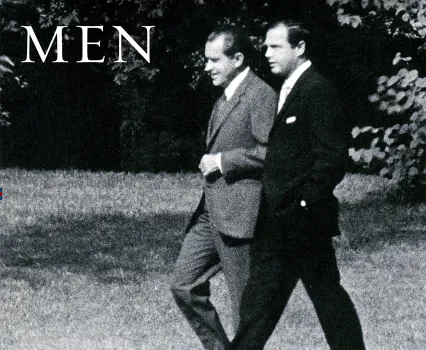
On July 16, 1973, Alexander Butterfield appeared before the Senate Watergate Committee. Minority counsel Fred Thompson asked a seemingly routine question about whether any listening devices existed in the Oval Office. Butterfield’s answer — four words that confirmed the existence of the Nixon tapes — set in motion the chain of events that led to President Nixon’s resignation on August 9, 1974.
The revelation of the taping system is widely considered one of the pivotal moments of 20th century American political history. Butterfield later described the experience in Bob Woodward’s 2015 book The Last of the President’s Men, which told his story in full.
“I was aware. Yes, sir.”
— Alexander Butterfield, Senate Watergate Committee testimony, July 16, 1973
Following the Watergate hearings, Butterfield served as Administrator of the Federal Aviation Administration from 1973 to 1975. He later became the subject of considerable historical scrutiny, and his decision to answer Thompson’s question truthfully has been both praised as an act of integrity and debated as a turning point in American constitutional history.
He is memorialized at 601 Gayley through the ongoing Epsilon Pi chapter history as one of our most consequential alumni — a brother whose four words changed the course of a presidency.
Notable Nu’s is a series celebrating distinguished members of the Epsilon Pi Chapter of Sigma Nu at UCLA.
Love · Honor · Truth